
The Basket of Unfinished Things
Beside the couch in my living room there is a basket that holds more good intentions than yarn, and more projects in progress than what I am going to tell you about. Most makers I know have one somewhere, whether its a basket in the lounge or a crate on a high shelf in the garage.
What to do with unfinished craft projects, and a yarn stash that has grown too big
Beside the couch in my living room there is a basket that holds more good intentions than yarn, and more projects in progress than what I am going to tell you about. Most makers I know have one somewhere, whether it's a basket in the lounge or a crate on a high shelf in the garage.
I'm going to be honest, I blame social media, because it cannot possibly be me: every project my basket currently carries was inspired by a beautiful reel or post. There are the tray cloths I have written about before, a beach cover-up skirt in a warm cream cotton bamboo yarn, an African flower granny square top in stone and black, and the almost completed Falling Blossoms shawl in a variegated cashmere-type yarn.
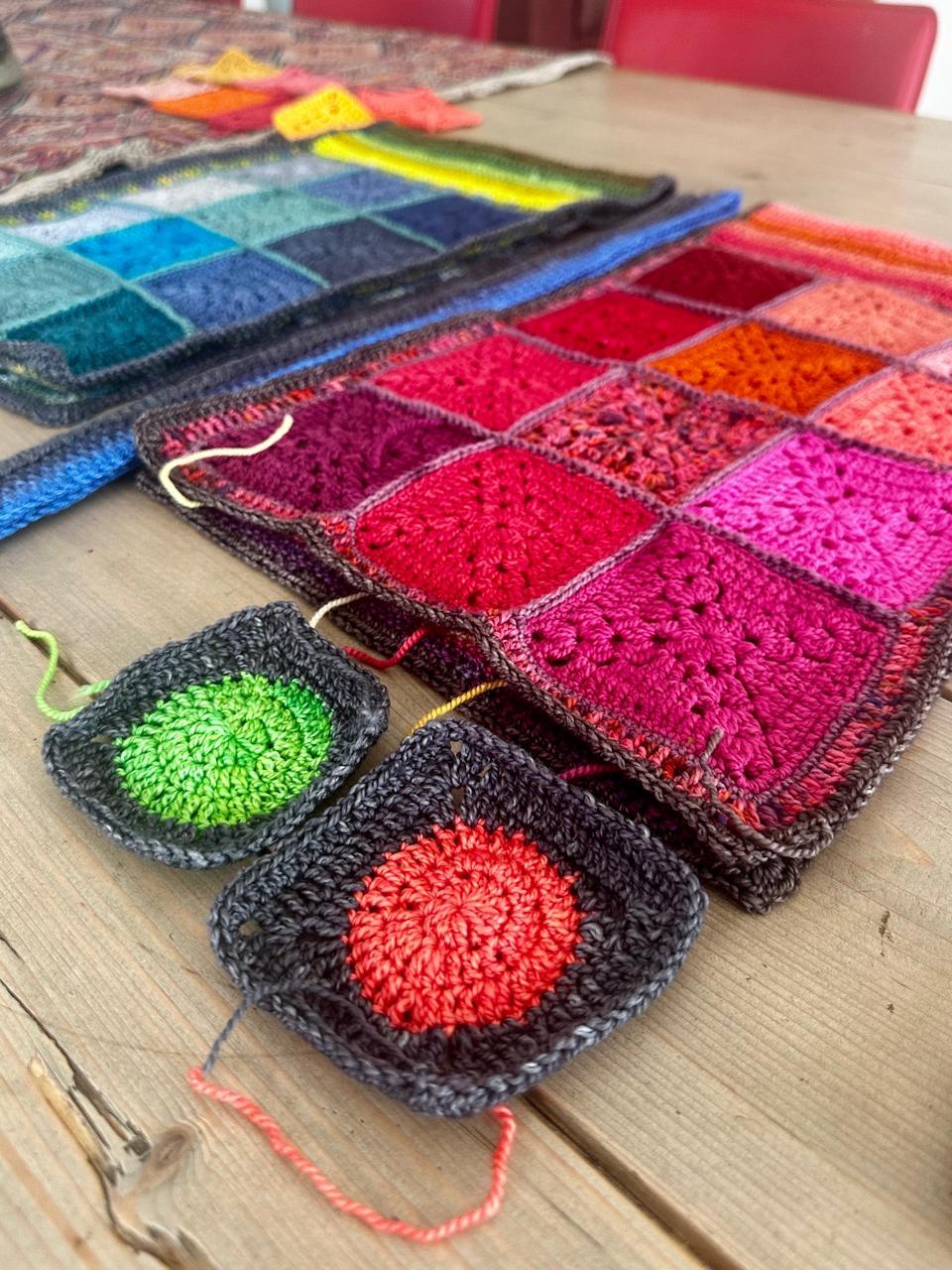
Unfinished things carry a quiet kind of weight, because each one is a small promise you made to yourself, and every time you lift the lid the basket reminds you of all the promises you haven't kept yet. The stash that grows up around it often comes from the same place I wrote about in What If I Don't Have Enough, the worry that the right yarn won't be there when you need it, so you buy it now, just in case, and then a little more for good measure.
It helps to stop seeing the basket as a record of failures and start seeing it as a handful of decisions that are simply waiting to be made. Whenever the lid no longer closes, tip the whole thing out onto the floor with a cup of tea beside you and give every project a fair hearing. In my experience each one can go one of four ways.
Finish it
Some projects only need an evening or two, and they've been waiting for no better reason than that something newer and shinier came along. Pick each one up and ask yourself two questions: do I still love this, and do I know whose hands it will end up in? When the answer to both is yes, it goes back on top of the basket, ready to be picked up next. A finished project with a person attached to it so often becomes the most treasured gift you give all year.
One winter I intentionally went through all my half-completed projects and systematically finished at least a dozen of them, and it taught me something I did not expect. For a notorious beginner of projects like me, that season was a lesson in the joy of completing something I had created myself, and the completion carries a warm satisfaction that can compete with the excitement of the start any day.
Make it into something smaller
Sometimes the love is still there but the project has simply outgrown your capacity. A blanket that has lost its charm at forty squares can become a cushion cover at four, and a lone sleeve makes a perfectly good cosy for a hot water bottle. The beach cover-up skirt in my own basket now carries a row of granny squares that started out as the beginning of a blanket. A project doesn't have to end the way it was first imagined, something I was reminded of when I mended my granny square merino blanket with my own version of Kawandi hand quilting.
Unravel it
Crocheters and knitters call it frogging, because you "rip it, rip it", and there's a particular satisfaction in watching a tired project turn back into a tidy ball of possibility. Unravelling isn't waste, since the yarn is every bit as good as the day you bought it. Wind it loosely around the back of a chair into a skein, tie it in a few places, wet it and hang it to dry with a light weight at the bottom, and the kinks relax so the yarn is ready to become something new.
I once knitted a skirt from sock-weight merino yarn that turned out to be impossible to walk in, so I frogged it, and that same yarn became a beloved, bright and happy cardigan that I wear often.
Let it go to someone else
Some projects, and a good deal of most stashes, belong in someone else's hands. A friend who crochets might be thrilled to finish what you started, and schools and the knitting circles at old age homes are often glad of yarn and fabric. Passing something on with a note about what it was meant to be is a lovely way of letting its story carry on without you.
I once bought a large quantity of lovely yarn on sale, and some of it went into a blanket, but when my disabled boy's caregiver wanted to knit a blanket for her new granddaughter, I was happy to gift her the rest. It is such a joy to share a stash, and to know that yarn I loved is becoming something precious in someone else's family.
If the stash itself has become the bigger story, the Letting Go books walk through it gently, from What If I Don't Have Enough to Happy and Home Free. A craft basket doesn't need to be empty, it only needs to hold what you love and have room in your life to make.
When the basket goes back in its place, lighter and with the lid closing properly again, the projects left in it start to feel like invitations rather than reproaches, and the next time you sit down with your hook you'll be choosing what to make instead of feeling guilty about what you haven't finished.
I wish I could tell you that I am a disciplined creator, but alas, I live by a more is more philosophy rather than a less is more one. What I can tell you is that I keep my projects well organised, and the basket next to the couch only holds what I am busy with right now. The rest lives in crates that keep it dust free and out of the way, and I often repack them to assess what is getting my attention now and what can wait for later. I usually have a crochet, a knitting and an embroidery project going at the same time, with a few containers of beads ready to be strung. I think it is important to have a system that works for you, based on the capacity and space you have, and on what excites you.
If it works for you to take each project from beginning to end before you start something new, that is exactly what you should do. Decluttering has a lot to do with knowing yourself and your capacity rather than following someone else's rule, and the same is true for creators and makers.
Something small to start with
Choose a single project from your basket, perhaps the one that is closest to done, and finish it, leaving the rest for another day. When you work the last stitch, take a moment to enjoy it before you reach for something new, because the warm satisfaction of completing something you created yourself can compete with the excitement of a beginning any day.