
A Slowstead the Size of a Balcony
Off the room where I now do my writing and keep my crafts there is a small balcony, with a lemon tree in a pot among the herbs and a chair set at exactly the right angle for a cup of tea in the afternoon. It is the smallest slowstead I tend, and I set it up partly because I love a challenge. I have said often enough that this way of living asks for no particular amount of ground, so it seemed only fair to test it on myself.
Off the room where I now do my writing and keep my crafts there is a small balcony, with a lemon tree in a pot among the herbs and a chair set at exactly the right angle for a cup of tea in the afternoon. It is the smallest slowstead I tend, and I set it up partly because I love a challenge. I have said often enough that this way of living asks for no particular amount of ground, so it seemed only fair to test it on myself.
I have to be honest about where most of my stories come from. Nearly everything I write about urban slowsteading is drawn from a city garden with fruit trees, two chicken coops, a duck pond and a medicinal garden, and I am aware that a reader in a flat can come away from all of that feeling welcome in principle and left out in practice. If that has been you, this blog is for you, and the balcony is my way of standing a little closer to where you are.
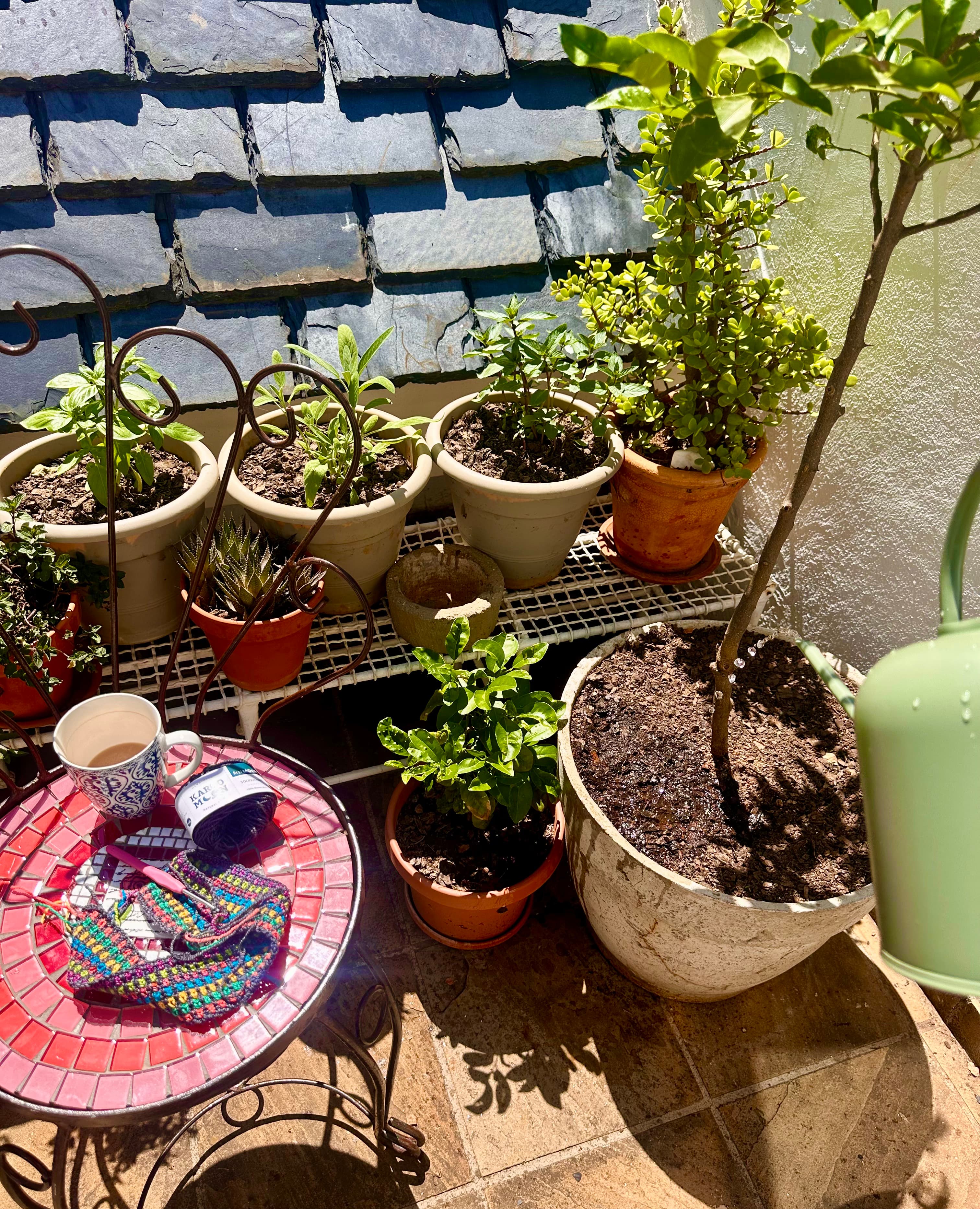
Within arm's reach of the door
My hope for the balcony is a simple one, which is that it makes the things I love easy to reach for and pleasant to return to. Nearness matters far more for that than size, and a balcony manages it as well as a large garden, sometimes better, because everything on it is within arm's length of the door.
A pot you pass every time you step outside gets picked from and noticed far more often than a bed at the bottom of a long garden that you visit only when you remember it is there, and I say that as somebody with a few of those beds herself.
What a small space is good at
Small spaces have strengths of their own, and it helps to work with them rather than apologise for them.
Everything in a container can move, which matters a great deal if you rent or expect to move house in a few years. A lemon tree in a pot travels with you, and so does a herb you have kept going through several seasons, so whatever you grow on a balcony becomes part of your household rather than part of the property you happen to be living in.
A compact kitchen is good at small batches, since a single jar of something preserved or a half batch of a favourite recipe suits a counter the size of a tea tray. That is where skills are learnt in any case, because failing at one jar costs a great deal less than failing at twelve.
Creativity takes up the least room of anything I do on the slowstead, and a crochet hook and a ball of yarn fit into a handbag with space to spare. None of it cares whether the chair you are sitting in belongs to a farmhouse or a flat on the fourth floor.
The main harvest on my own balcony is not lemons at all, since I set the chair there for afternoon tea and for slowing down. On the afternoons I actually sit in it, ten minutes among the herbs with the city carrying on all around me does a different kind of good from anything the vegetable garden gives, and it is the kind a small space is particularly good at giving.
Renting, sharing and other limits
If you rent, you may not be allowed to dig or drill, and if you share a house, the kitchen may not be yours to arrange. Neither of those is a reason to wait, since urban slowsteading has always been about the life you actually have rather than the one you are waiting for, and a rented flat is that life just as fully as a house with a title deed.
A shelf in a shared kitchen that is entirely yours, kept in order and stocked with the things you really cook with, is a slowstead of sorts, and so is a corner of a bedroom with a comfortable chair and a basket of handwork beside it.
I would go further and say that a limit can make the practice clearer. When there is no room for everything, you find out quite quickly which one or two things you actually want, and those are very often the ones that last.
The real limit is rarely the space
When somebody says they have no space for slowsteading, they very often mean something other than square metres. There may be no room in the day, or no room in a household that is already running at the edge of what it can carry, and a bigger garden would help with neither of those.
I wrote three books about decluttering before I ever wrote about growing anything, and the longer I slowstead, the more sense that order makes to me. A small space with room in it will always be easier to live in this way than a large one with none, and a full life with a balcony is a far better starting point than a full life waiting for acreage.
A balcony has one more advantage here, which is that it can be tended in the minutes you really have, rather than in the free afternoons you keep meaning to find. Ten minutes with a watering can and a pair of scissors is a complete visit, and on most days that is all a few pots will ask of you.
Your first container
If you would like somewhere to begin, choose one container and one place to put it, somewhere you pass every day without having to make a special trip. Then decide what it is for, whether a herb you will actually cook with or a dwarf citrus tree you are willing to wait on, and give it a few minutes of attention each time you pass, which is all most potted plants really need. The container does not need to be beautiful either, since an old bucket with a few holes punched in the bottom grows herbs every bit as well as anything bought for the purpose.
If you have no outside space at all, let the container be a basket instead, with a project in it that you can pick up in the time it takes the kettle to boil and put down again without any fuss when the kettle clicks off.
Whichever you choose, put it where you will see it from the place you sit most often. A slowstead you can see from your chair is one you will return to, and returning is most of what this way of living asks of anybody, in a house with a garden or in a flat with a single door to the outside.
What does the smallest slowstead in your life look like, and what does it give you that a bigger one might not? I would love to see it through your eyes, so do leave me a comment and tell me.